
Listen to this article
French perimeter drain for foundation protection and moisture control.
The perimeter French drain for foundation protection and moisture control helps you remove water away from your foundation and keep your house dry. Here you will understand what it is, how it works, when to use it, which materials are safe, how to install it simply, and how to maintain it without hassle—all explained in easy-to-understand language, with practical tips and ways to protect your home along with waterproofing.
Main conclusions
- The French perimeter drain carries the water away from your house.
- It protects your foundation and prevents cracks.
- It reduces water pressure in the soil near the foundation.
- It needs the right incline and the correct materials to function properly.
- It requires regular cleaning and inspection to last.

What is a perimeter French drain and why do you need one for foundation protection and moisture control?
The French perimeter drain for foundation protection and moisture control is a simple system: a perforated pipe encased in gravel, installed around the foundation to collect groundwater and conduct it to a safe point. When it rains, the system prevents the base of the house from becoming waterlogged, reducing leaks, mold, and the risk of cracks.
You need it when you want to protect the foundation from poorly drained soil, a high water table, or continuous water accumulation near the walls. It's a preventative measure that is usually much cheaper than subsequent structural repairs.
How does the French perimeter drain work to remove water from the foundation's surroundings?
The system uses a perforated pipe supported on gravel. Water enters the gravel, reaches the pipe, and is then gravity-fed to an inspection chamber, manhole, or pumping station. The gravel filters out sediment; the geotextile membrane prevents soil from clogging the system.
When to use perimeter drainage for foundations to prevent moisture and cracking.
Install drainage if the soil is clayey, if there are puddles near the walls, stains on the baseboard, sinking floors, or a history of water infiltration. It is also recommended in areas with a high water table, on slopes, or after construction work that has altered the natural flow of water.
Practical function of the drainage system for foundations.
In practice, perimeter drainage collects and directs water to reduce hydrostatic pressure against the foundation, protecting against moisture, mold, and structural damage.



Benefits of perimeter French drainage for your home and its foundation.
- Less moisture in basements and walls.
- Reducing water pressure on the foundation.
- Reduced risk of cracking and mold.
- Soil protection against erosion and settlement.
- Savings on repairs in the long run and improved indoor air quality.
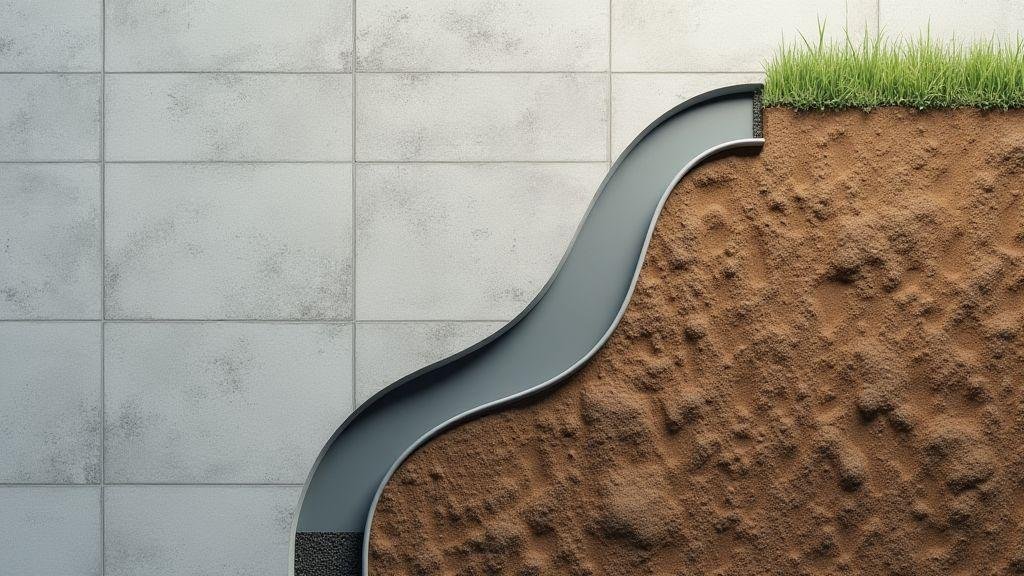
Easy and safe materials that make up the perimeter French drain.
The French perimeter drain for foundation protection and moisture control uses simple and readily available materials:
- Perforated pipe (standard 100 mm PVC).
- Clean crushed stone (filling layer).
- Geotextile blanket (to prevent clogging).
- Inspection box / manhole.
- Connectors, clamps and, if necessary, a sediment filter.
The perforated pipe captures the water; the gravel creates a drainage bed; the geotextile prevents soil from entering. Durable materials minimize maintenance and increase the system's lifespan.
Why choose durable materials?
Durable components prevent frequent repairs. Quality pipes and sheets keep the system functioning for decades, consistently protecting the foundation.
Clear steps for the design and installation of perimeter French drainage for foundation protection.
Think of the drain as a "straw" that carries water away from the foundation. Plan carefully: mark the route, check existing plumbing, define the slope, and choose accessible outlets.
Essential materials: perforated pipe, crushed stone, geotextile fabric, inspection boxes, and connectors. Work with a schedule: excavation, pipe laying, testing, and backfilling.
Project: layout, slope and starting points
- The layout should be contiguous to the base of the foundation, avoiding trees and pipes.
- Recommended slope: 1% to 2% (1–2 cm per meter).
- Outlets to the street, retention basin, storm drain or manhole.
Basic step-by-step
- Mark the perimeter and check for obstacles.
- Dig a trench of adequate width and depth.
- Place a layer of gravel (5–10 cm).
- Position the perforated pipe with the holes facing down or to the side, as per the design.
- Wrap with geotextile and fill with gravel.
- Cover with soil and compact in layers.
- Install inspection boxes and test the drainage with water.
Best practices: keep an inspection box easily accessible, use quality geotextile, and compact the filling to prevent subsidence.

How to maintain a perimeter French drain without complications.
The perimeter French drain for foundation protection and moisture control requires simple inspections: check the runoff after rain, clean manhole covers, and remove leaves and sludge from the outlet. Light annual cleanings and checks every 6 months (spring and autumn) are usually sufficient; a deep cleaning every 3–5 years depends on the surroundings.
How to safely check and clean
Make a round of the house, look for puddles, damp patches, and open the manholes. Useful tools:
- Durable gloves
- Protective eyewear
- Garden hose with pressure washer
- Short serpentine or rigid rod
- Small shovel
Use the hose to push sediment through and the drain snake to clear blockages. If there is a severe blockage, call a professional to avoid damaging the pipe.
Warning signs that require urgent maintenance.
- Water entering the house.
- Damp patches or bubbles in the paint.
- The garden is constantly waterlogged next to the foundation.
- New cracks or sinking floors.
Recommended frequency: check twice a year and clean as needed.
How to combine waterproofing and French drainage to prevent water infiltration in foundations.
The combination of waterproofing with perimeter French drainage for foundation protection and moisture control is the most efficient solution: apply a waterproofing membrane to the exterior walls, protect it with a rigid board, and install the perforated pipe over gravel and geotextile at the base of the foundation. The membrane blocks water that attempts to penetrate the wall; the drain collects water from the ground and carries it away, relieving hydrostatic pressure.
Order of execution: excavation → waterproofing application → membrane protection → drain installation → backfilling with permeable soil. Maintain continuous joints between the membrane and the drain outlet to prevent infiltration paths.
When to use drainage membranes
Use the combination when there is a high water table, clay soil, construction on a slope, or a history of seepage. In well-drained soils with no history of moisture, the isolated membrane may be sufficient, but monitoring is essential.
Strategies for complete foundation protection with French drains.
- Geotextile to prevent clogging.
- Well-graded crushed stone for drainage.
- Perforated pipe with a suitable diameter (100 mm is common).
- Protective plate over the membrane.
- Gentle slope for safe exit; pumping well if needed.
- Inspection boxes for maintenance.
Conclusion
The French perimeter drain for foundation protection and moisture control diverts water away from the foundation, reduces soil pressure, and prevents cracking, mold, and costly repairs. With properly placed perforated pipe, gravel, and geotextile membrane, and regular maintenance, the system works for decades. Combine the drain with proper waterproofing, and you'll have double protection for your home.
Want to learn more and take good care of your home? Visit https://dicasdereforma.com.br.
Frequently Asked Questions
- What is a perimeter French drain for foundation protection and moisture control?
It is a system of perforated pipes and gravel around the foundation that channels water away, protecting the house from moisture.
- How does a perimeter French drain work?
Groundwater enters the gravel, is collected by the perforated pipe, and carried by gravity to a drainage point.
- Why does a French drain protect the foundations?
Because it removes water, which weakens the soil and reduces hydrostatic pressure against the walls.
- When should I install a French drain?
If there are puddles next to the wall, damp patches, a high water table, or clay soil. Ideal during construction or soon after initial signs of dampness.
- Where should the drain be placed?
Around the perimeter of the foundation, next to the footings or raft foundation, at the base of the wall.
- How much does it cost to install a French drain?
The cost varies depending on the square footage, soil type, access, and materials. Request local quotes based on your project.
- Does it need maintenance?
Yes. Semi-annual checks and periodic cleanings prevent blockages and malfunctions.
- Does the drain prevent water infiltration into the basement?
It greatly reduces the chance of water infiltration when properly designed and combined with waterproofing.
- Does it work in clay soil?
Yes, but it may require filters, more frequent maintenance, and attention to the design because it drains slowly.
- Can a French drain damage the building?
If installed incorrectly, it can cause problems; therefore, good design and execution are essential.
- What is the system's lifespan?
With the right materials and workmanship, it can last for decades.
- Can I install it myself?
It's possible on small projects if you master the steps, but professional help is recommended for complex cases.
- How to choose the right material?
Use heavy-duty perforated pipe, clean gravel, and good quality geotextile fabric to prevent blockages and ensure drainage.