Listen to this article
strategies for adapting cities to climate change for you to transform the city with urban green infrastructure, sustainable urban drainage and reinforcement works that reduce flooding, heat and risks. In this article you'll find proven benefits, examples of retention parks, basins and green roofs, drainage techniques, criteria for waterfront and hillside works, and how to integrate everything into your works plan. You'll learn how to prioritize vulnerable areas, demand reinforcement of critical infrastructure, use policies and funding, and ensure maintenance e social participation with simple indicators. It's time to act.
Key Lessons
- Plan clear detours to keep traffic moving
- Protect people, businesses and access during construction work
- Communicate deadlines and changes in advance
- Adopt green solutions to reduce impacts
- Involve the community and secure funding
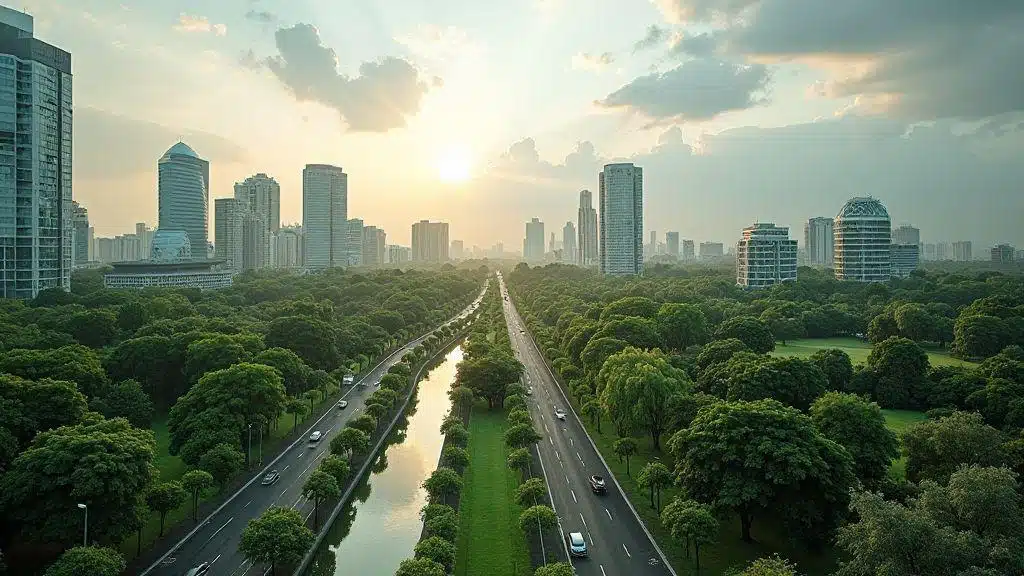
Urban green infrastructure as strategies for adapting cities to climate change
A green infrastructure works like a sponge and an umbrella at the same time: absorbs water, reduces flood peaks and protects residents from the heat. When you include retention parks, basins and green roofs in its design, the city becomes more resistant. This changes the flow of rain and provides shade where it is most needed.
Every construction site that incorporates greenery brings social and technical benefits: it improves the AIR QUALITY, It reduces the temperature in the streets and creates spaces for the community. These gains show up quickly: less flooding, fewer heat islands and more recreational areas.
To move forward, treat green infrastructure as part of the construction budget and schedule. Think big and start small: a well-executed pilot project convinces the public and frees up resources. To structure proposals and partnerships, see examples of case studies that show practical results.
Proven benefits of urban green infrastructure projects to reduce flooding and heat
Projects with basins and retention parks delay and store rainwater, reducing the volume that reaches the drainage system at peak times. Studies and pilots show a significant reduction in flooding in neighborhoods that have adopted these measures.
The green roofs trees shade the asphalt and vegetation evaporates water, cooling the air. For you, this means less cooling costs in buildings and more comfort on the streets.
Examples of urban adaptation works with retention parks, basins and green roofs
Cities like Copenhagen (project Cloudburst), Singapore (Bishan-Ang Mo Kio Park) and Seoul (Cheonggyecheon) show how to integrate retention, leisure and biodiversity. In Brazil, São Paulo and Curitiba have pilots of green roofs and detention basins with clear local benefits.
How to integrate urban green infrastructure projects into your construction plan
- Assess risks and hotspots; prioritize areas with greater exposure to flooding and heat.
- Define low-cost, high-impact actions; involve the community right from the start.
- Seek public and private partnerships and ensure maintenance and monitoring.
- Prefer multifunctional solutions that generate leisure, retain water and reduce the temperature.
Sustainable urban drainage and drainage works as strategies for adapting cities to climate change
See drainage works as tools for reduce risk, to protect lives and maintain everyday life when the rain hits. Effective designs combine green infrastructure (rain gardens, green roofs) with engineering (galleries, canals, detention basins) to slow down runoff and increase permeability the soil. This improves the quality of the water that returns to the rivers and aquifers.
Planning sustainable drainage requires considering the local climate, socio-economic profile and maintenance future. Major works protect flood corridors; smaller interventions - vegetated ditches, permeable sidewalks - improve life on the block. Prioritize solutions that make the neighborhood more resilient and welcoming.
Proven techniques for sustainable urban drainage and drainage by works
There are tried and tested measures that you can defend:
- Permeable paving for parking lots and sidewalks
- Detention basins to store rainfall peaks
- Vegetated ditches and swales (rain gardens) that conduct water with infiltration
- Green roofs that retain some of the rain
- Foundation protection solutions such as perimeter French drain
The combination of gray and green infrastructure brings more benefits than each one in isolation - think of parks that act as temporary reservoirs in floods.
When to prioritize drainage interventions in vulnerable areas of the city
Prioritize where the rain is already causing frequent damage and where people with less capacity to recover live: areas with high waterproofing, The community can also identify hotspots such as exposed slopes, floodplain occupations and proximity to hospitals and schools. Use simple data - flood history, risk maps and the presence of critical infrastructure - and involve the community to identify hotspots. Practical assessments of risk of flooding help define priorities.
Practical steps for planning sustainable urban drainage works in your neighborhood
- Do local mapping: flood hotspots, land use and vulnerable population.
- Prioritize interventions with the greatest social impact and the shortest implementation time.
- Combine green solutions (rain gardens, permeable paving) with drainage works (basins, galleries).
- Look for partnerships: town halls, universities and NGOs.
- Design clear maintenance and train residents in small preventive actions.
- Monitor results and adjust according to rainfall response.
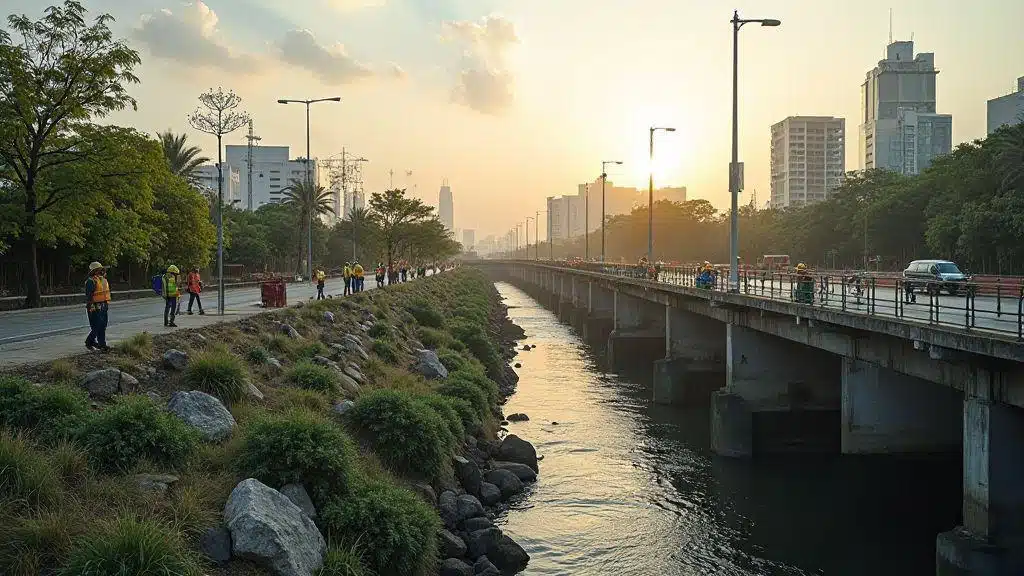
Strengthening critical urban infrastructure to increase resilience as adaptation strategies for cities affected by works
When bridges, roads and networks fail, essential services are compromised. Strengthening critical infrastructure is a direct action between works and climate response. Projects such as Delta Works and Thames Barrier protect millions; local interventions such as the restoration of the Cheonggyecheon change microclimates and quality of life. Consult us case studies for applicable examples.
When planning, focus on resilience and human impact. As part of the strategies for adapting cities to climate change, the reinforcement of structures combines heavy engineering with green solutions: raising runways, improving foundations, installing permeable sidewalks and creating urban retention zones.
Risk assessment to prioritize reinforcement of critical urban infrastructure (bridges, roads, networks)
- Identify risks: flooding, landslides, corrosion and overloading.
- Cross-reference with criticality: which structures serve hospitals, shelters and evacuation routes?
- Include social vulnerability in the calculation - roads that give access to more vulnerable communities have higher priority.
Technical retrofit and reinforcement solutions for resilient urban infrastructure
For bridges and roads: strengthening foundations, increasing sections, protecting against corrosion and raising decks. In seismic locations: base and joint insulation. For urban networks: electrical redundancy, elevation of switchboards, pumps with backup power; on the ground, permeable sidewalks and green roofs reduce flood peaks. See how to increase capacity and resilience on construction sites at good building practices and protect projects from interruptions with guidelines in risk management.
Simple checklist to demand reinforcement of critical infrastructure on construction sites
- Complete risk mapping (flooding, erosion, corrosion)
- Criticality analysis: routes and structures linked to essential services
- Retrofit options compared (cost, time, impact)
- Integrated green solutions (permeability, vegetation)
- Maintenance plans with clear managers for 10-20 years
- Measurable success indicators (reduction in downtime, retained volume)
- Transparency: public reports and community participation
- Contractual clauses that oblige corrections if performance falls short of what was promised
Urban risk mitigation works on the waterfront and hillsides as urban adaptation to climate change through works
Mitigation works are an investment in security e quality of life. On shorelines, coastal defenses reduce erosion; on hillsides, retaining walls prevent landslides. Each intervention changes the local climate and people's routines, which is why community participation is vital - technical solutions with a public voice produce fairer and longer-lasting results. Before designing, consider the environmental repercussions and the relationship between works and disasters in impact analyses.
Combine works with policies and education: integrate green infrastructure, The use of drainage systems and land use plans makes a difference. These actions are part of the strategies for adapting cities to climate change that you can claim.
Types of urban risk mitigation works: walls, retaining walls and coastal defenses
- Retaining walls and anchors to stabilize slopes
- Breakwaters, beach restoration and rock revetments to protect shorelines
Assess environmental impacts: hard solutions can alter sediments and affect fishing and bathing; understand how local biodiversity can be affected.
Integration between mitigation works and adaptive urban planning
Works need to be part of an urban plan that takes into account risks, growth and future climate. Engineering and planning together avoid repeated spending and make interventions coherent.
Principles: risk reduction, maintenance, cost-effectiveness and social inclusion - always involving residents from the design stage.
Criteria for choosing urban risk mitigation works in your city
Prioritize risk mapping, cost-benefit, social and environmental impact, ease of maintenance and adaptability to future scenarios. Choose works that reduce the vulnerability of the most exposed populations and include clear operational plans.
Adaptive urban planning through public works and policies to accelerate cities' adaptation strategies to climate change
Urban planning is an action map: physical works and public policies go hand in hand. By integrating detention basins, flood parks and mangrove restoration with municipal laws, you accelerate cities' adaptation strategies to climate change and protect vulnerable populations. Well-planned works transform sidewalks, streets and squares into retention and cooling infrastructure.
Public policy stands in the way: a master plan that prioritizes green infrastructure, Targeted funding and clear rules change the speed of interventions. Regulate land use, define risk areas and offer tax incentives for adaptation projects - see effective policies and incentives.
Legal instruments, financing and public policies for adaptation by works
Laws and financial instruments turn project into work:
- Master plans that integrate climate risk
- Municipal Climate Fund to finance adaptation works
- Tax incentives for green infrastructure projects
- Public-Private Partnerships (PPP) for major construction projects
- Agile environmental licensing with resilience criteria
Standards and protocols for urban resilient infrastructure projects and urban adaptation works
Technical standards (ABNT and municipal), green infrastructure guides and risk assessment protocols standardize criteria for drainage, slope stability and retention capacity. Applying tested references reduces errors on site and protects residents; check out examples of sustainable standards and practices.
| Standard/Protocol | What it covers | Application example |
|---|---|---|
| Local technical standards (ABNT and municipal) | Construction and material requirements | Dimensioning drainage systems |
| Green Infrastructure Guides | Retention projects, permeable sidewalks, green roofs | Flood parks and green corridors |
| Risk Assessment Protocols | Methodologies for identifying critical areas | Urban flood risk mapping |
How to use public policies and planning to make adaptation work viable
Align objectives in the master plan, create your own lines of financing and simplify permits for resilience projects. Engage the community and technicians from the outset; projects born of public acceptance move faster and cost less in the long run. Use risk data to prioritize actions and model projects with examples of climate mitigation through construction.
Operation, maintenance and social participation to ensure the success of adaptation strategies for cities affected by works
Building is just the beginning. Adaptation works reduce flooding and mitigate heat islands, but without constant operation and maintenance become an expense and a risk. Define responsibilities, an ongoing budget and simple maintenance routines - cleaning culverts, pruning, checking pumps - to preserve the climatic function of the site.
Social participation keeps the project alive: involving residents reduces vandalism, speeds up repairs and improves acceptance. When the community participates, maintenance is faster and the works respond better to changes in the climate. Integrate environmental impact assessment and consultation processes to guarantee social justice.
Importance of ongoing maintenance in urban adaptation works and urban resilient infrastructure
Ongoing maintenance protects investment and people's lives. Regular inspections detect small problems before they become catastrophes. Well-maintained rainwater parks attract community use, reduce feelings of insecurity and increase thermal comfort. Publish simple reports to generate political support and transparency.
How to involve residents in urban adaptation projects, monitoring and works
Invite the community from the first drawing board: workshops, guided tours and chats in the square. Show prototypes, maps and simple simulations. Post-delivery, turn residents into monitoring partners: trainings, neighborhood groups, mobile photo reports, WhatsApp forms and monthly meetings keep the project alive. Better understand the social impacts of the works to design effective participation programs.
Simple indicators you can use to monitor the performance of adaptation work
- Frequency of flooding
- Fault response time
- Vegetation cover (shade in m²)
- Average local temperature before and after
- Residents' satisfaction
Record monthly observations and photos; create a maintenance calendar with deadlines and responsible parties. Include lifecycle and waste management for more sustainable construction work, based on the following practices construction waste management.
How these strategies strengthen the city
Strategies for adapting cities to climate change become effective when works, policies and the community work together. Integrated interventions - green infrastructure, sustainable drainage and critical reinforcement - create multiple benefits: reduced flooding, greater thermal comfort and protection of lives and property. Start with a diagnosis, prioritize vulnerable areas, implement pilots and scale up based on results. Be inspired by projects that show how construction is adapting to climate change.
Conclusion
You have in your hands a practical roadmap for transforming the city. By combining green infrastructure, sustainable urban drainage e strengthening critical infrastructure, you reduce flooding, fight heat and save lives. Prioritize vulnerable areas, demand ongoing maintenance and social participation from the very first draft. Works with vigilance become assets; well-done pilot projects open the door to larger investments.
Use available tools: public policies, legal instruments e financing. Combine gray and green solutions. Ask for transparency and simple indicators. Monitor with the community. When planning and construction work together, the city and its people are more resilient to the future.
Don't wait for disaster to strike. Start now: map risks, involve neighbors, implement a pilot, monitor and adjust. Be the voice demanding technical responsibility and social justice in construction choices.
Want to keep learning and be inspired by practical examples and guides? Read more articles at https://dicasdereforma.com.br and stay ahead of the changes.
Frequently Asked Questions
- What are urban adaptation works?
Adaptation works are physical interventions that improve infrastructure. They form part of cities' adaptation strategies to climate change.
- How does a permeable street help my city?
It reduces flooding and damage and is one of the strategies for adapting cities to climate change. See how to apply permeable paving in urban spaces at practical examples.
- Why invest in parks and green areas?
Parks refresh the city, improve air quality and are part of cities' adaptation strategies to climate change.
- Are flood containment works expensive?
They may have an initial cost, but they prevent major losses; they are part of cities' adaptation strategies to climate change.
- How can public buildings be adapted?
Raise floors, change materials and make spaces safer - actions that are part of strategies to adapt cities to climate change.
- Is it possible to adapt poor neighborhoods with construction work?
Yes. Simple projects and prioritizing basic services help a lot and are part of cities' adaptation strategies to climate change.
- What works help in extreme heat?
Green roofs and street shading reduce local temperatures; these are strategies for cities to adapt to climate change.
- How can the community be involved in the work?
Listen, inform and empower. This builds support and maintenance, strengthening cities' adaptation strategies to climate change. Also consider participatory assessments of environmental impact.
- Does drainage work solve everything?
No - it has to be combined with greenery and management. They are part of cities' strategies for adapting to climate change.
- How long does it take to see results?
From months to years. You'll see a reduction in flooding and heat as city adaptation strategies to climate change are implemented.
- How can adaptation work be financed?
Seek public funds, green credit and partnerships; these mechanisms accelerate cities' adaptation strategies to climate change. See examples of public policies and incentives.
- Do works reduce future risks?
Yes. They reduce damage and losses, protecting lives and property - they are strategies for adapting cities to climate change.
- Where to start the work in my city?
Make a diagnosis, prioritize vulnerable areas and plan by impact. This is the way to implement strategies to adapt cities to climate change. See the practices of construction mitigation to guide the first steps.